
The traditional asphalt roof you’ve relied on for years might actually be the primary reason your Vancouver commercial cooling bills spiked by 15% last July. If you’re managing a property in Southwest Washington, you know that the combination of 40+ inches of annual rainfall and intensifying summer heat puts immense pressure on your building’s envelope. You shouldn’t have to deal with the anxiety of a “surprise waterfall” in your warehouse every time a Pacific Northwest storm rolls through. We believe you deserve a roof that works as hard as you do without demanding constant repairs or high-pressure maintenance cycles.
Many local business owners are discovering that tpo flat roofing systems offer the most dependable defense against our region’s specific climate challenges. This 2026 comparison guide breaks down the performance, installation costs, and regional advantages of TPO to help you decide if it’s the right investment for your property. We’ll examine how these reflective membranes eliminate moss growth and provide a 20 year, leak-free solution that prioritizes your peace of mind and long-term protection. Discover how this modern material can lower your energy bills and provide a stress-free roofing experience for decades to come.
Key Takeaways
- Learn how the multi-layered composition of TPO provides superior protection and energy savings for commercial properties in the Pacific Northwest.
- Discover why tpo flat roofing systems are the preferred choice for Vancouver businesses looking to balance affordable upfront costs with long-term durability.
- Compare the performance and chemical resistance of TPO against PVC and metal options to determine the best fit for your specific facility.
- Identify the essential installation steps, from substrate prep to insulation choice, that guarantee your new roof survives Southwest Washington’s toughest weather.
- Gain peace of mind by understanding how manufacturer-backed warranties and professional certifications protect your investment for decades.
What is a TPO Flat Roofing System?
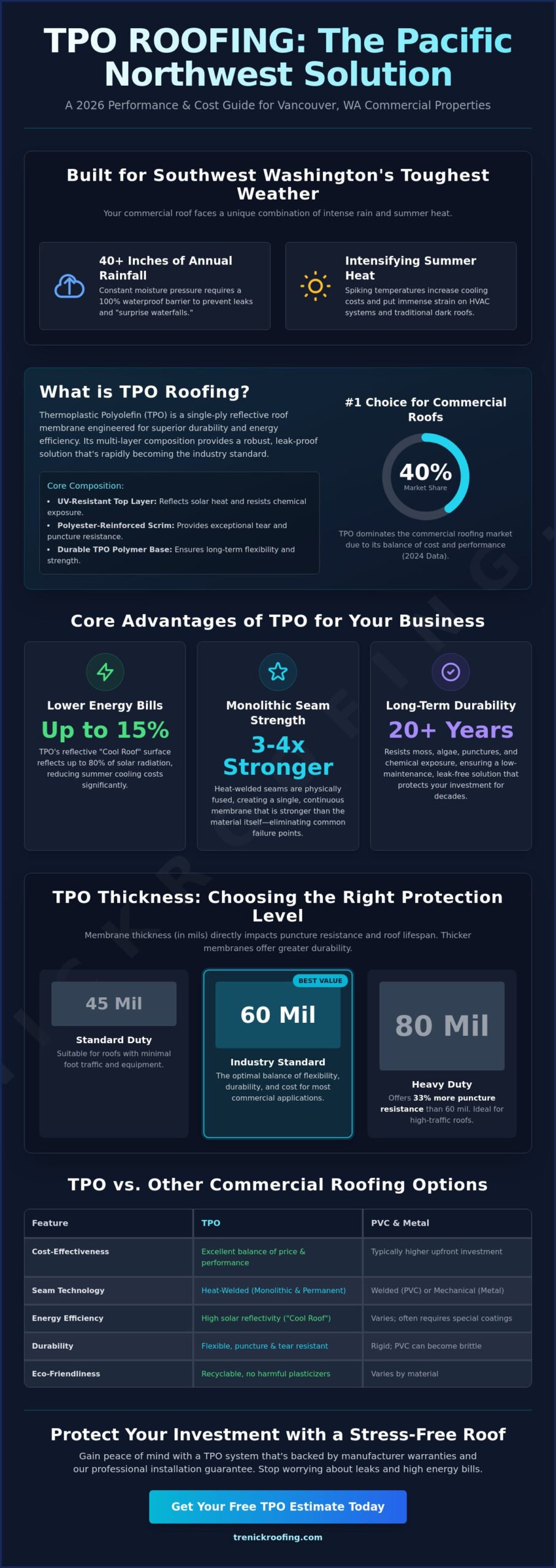
TPO flat roofing systems provide a high-performance solution for property owners in Vancouver and Battle Ground who need durable, weather-resistant protection. These systems use a single-ply membrane technically known as Thermoplastic Polyolefin (TPO). This material combines the long-term durability of EPDM rubber with the high-strength heat-welding capabilities of PVC. The membrane features a three-part construction: a TPO polymer base, a polyester-reinforced scrim for tear resistance, and a specialized top layer designed to resist UV rays and chemical exposure. TPO is a heat-welded, energy-efficient alternative to EPDM and BUR.
According to 2024 industry data, TPO has captured 40% of the commercial roofing market share. This rapid growth stems from its ability to offer a balance of cost-effectiveness and superior performance. For homeowners and business owners in the Pacific Northwest, this material provides a reliable barrier against heavy rainfall and fluctuating temperatures. It reflects solar heat, which can reduce cooling costs by up to 15% during the summer months in Vancouver.
The Science of Heat-Welded Seams
Installers use specialized hot-air welding tools to fuse the edges of TPO sheets together. This process creates a monolithic, waterproof bond across the entire roof surface. Unlike taped or glued systems that rely on adhesives prone to degradation over time, heat-welded seams are 3 to 4 times stronger than the membrane itself. Seam integrity is the #1 factor in flat roof longevity. A fused seam effectively becomes one continuous piece of material, eliminating the most common failure points found in older roofing styles. This professional application ensures long-term protection and peace of mind for properties in Battle Ground.
Thickness and Roll Sizes: What Matters?
Membrane thickness is measured in mils, and your choice directly impacts the lifespan of your roof. Common options include:
- 45 Mil: A standard entry-level thickness suitable for roofs with minimal activity.
- 60 Mil: The industry standard that offers a balanced blend of flexibility and durability.
- 80 Mil: Provides 33% more puncture resistance than 60 mil; it’s the best choice for roofs with heavy foot traffic or frequent HVAC maintenance.
Standard roll widths usually range from 10ft to 20ft. Using 20ft rolls reduces the total seam count by up to 50% on large surfaces. Fewer seams mean fewer opportunities for leaks to develop. When selecting a system, we look at your specific building layout and equipment needs to determine the ideal thickness and roll configuration for maximum reliability.
Why TPO Roofing is Ideal for Vancouver & Longview Businesses
Vancouver and Longview businesses face unique environmental pressures that demand high-performance materials. TPO flat roofing systems provide a reliable solution because they combine the flexibility of rubber with the durability of heat-welded seams. This chemical bond creates a monolithic surface that prevents leaks, even when Clark County receives its average 42 inches of annual rainfall. Our local climate requires a roof that doesn’t just sit there; it needs to actively protect the structure from constant moisture and fluctuating temperatures.
During our increasingly hot summers, TPO’s reflective properties reduce surface temperatures by up to 50 or 60 degrees compared to traditional built-up roofs. This “Cool Roof” technology isn’t just about comfort; it’s a strategic choice for long-term protection of HVAC units and lower cooling costs. By reflecting up to 80% of solar radiation, these membranes keep the building’s interior stable while reducing the strain on mechanical systems. This efficiency is a core reason why TPO is the fastest-growing segment in the commercial roofing industry for 2026.
High humidity in Cowlitz County often leads to mold and algae growth on traditional materials. TPO membranes are engineered to resist these biological threats, maintaining their integrity and appearance for decades. These systems are also designed to withstand the heavy wind gusts common in the Columbia River Gorge. They meet the strict wind uplift requirements of local building departments, ensuring your investment stays secure during winter storms. We believe in providing peace of mind through materials that are as hardworking as the businesses they cover.
Managing Heavy Rainfall and Drainage
Flat roofs in Vancouver, WA aren’t actually flat; they require a minimum slope of 1/4 inch per foot to prevent ponding water. Standing water is the primary cause of premature roof failure in the Pacific Northwest. We ensure TPO installations include optimized internal drains and scuppers to move water off the building quickly. For total water management, many owners integrate their new roof with seamless gutter installation to protect the building’s foundation and siding from overflow. Proper drainage is the foundation of a dependable commercial roof.
Local Building Codes and Standards
Compliance with the Washington State Energy Code (WSEC) is mandatory for commercial properties. TPO helps businesses meet these stringent R-value and solar reflectance requirements. In Clark County, installations must also account for specific wind load specifications that vary by building height and location. Our team prioritizes professional inspections throughout the process to ensure every detail meets or exceeds local safety standards. This commitment to integrity ensures your project remains code-compliant and eligible for manufacturer-backed warranties. If you’re concerned about your current roof’s condition, you can schedule a professional roof inspection in Vancouver to catch small issues before they become costly repairs.
TPO vs. PVC vs. Standing Seam Metal: Choosing Your Commercial Roof
Selecting a roof for your facility in Vancouver or Battle Ground involves more than just picking a material. It’s about matching the system to your specific operational needs and long-term financial goals. While tpo flat roofing systems dominate the market for their balance of performance and value, they aren’t a universal solution for every building type.
TPO vs. PVC: The Single-Ply Battle
The single-ply market is largely a choice between TPO and PVC. TPO is generally the more budget-friendly option, providing excellent heat reflectivity that helps lower cooling costs during our increasingly warm Pacific Northwest summers. It offers high puncture resistance, which is vital if your roof houses HVAC units that require frequent servicing. However, PVC has a distinct advantage for specific industries. If you operate a restaurant or a manufacturing plant in Vancouver that exhausts oils or chemicals, PVC is the necessary choice. TPO membranes can degrade quickly when exposed to animal fats or grease, while PVC is engineered to withstand these substances without swelling or losing integrity.
Regarding temperature swings, both materials handle the Vancouver climate well. TPO is highly flexible, allowing it to expand and contract as temperatures shift from freezing winter nights to 90-degree summer days. PVC remains slightly more pliable over its lifespan due to its chemical composition, but for most standard retail or warehouse applications, TPO provides the protection you need without the premium price tag of PVC.
When to Invest in Metal Instead
For property owners in Battle Ground who prioritize longevity over initial savings, standing seam metal roofing is often the superior investment. According to 2024 industry data from the National Roofing Contractors Association, a TPO system typically offers a 20 to 25 year service life. In contrast, a high-quality metal roof can easily exceed 50 years. This longevity provides ultimate peace of mind for mixed-use developments or buildings where the roof’s visual profile is part of the architectural appeal. Before committing to a metal system, it’s worth consulting our guide on choosing local metal roofing companies in Vancouver and Battle Ground to ensure you select a qualified specialist and avoid costly installation mistakes.
Weight is a critical factor when choosing between these systems. TPO flat roofing systems are incredibly lightweight, making them ideal for older structures that cannot support heavy loads. A 24-gauge steel standing seam system weighs approximately 1.5 pounds per square foot. We always conduct a structural assessment to ensure your existing building can handle the additional mass of metal before recommending a replacement. While the upfront cost of metal is higher, the reduced need for replacement over a 50 year period often results in a lower total cost of ownership.
Maintenance protocols in the Pacific Northwest focus heavily on moisture management. TPO and PVC require biannual inspections to ensure seams remain watertight and drains stay clear of organic debris. Metal roofs require less frequent surface maintenance but need regular checks of fasteners and flashing points. In our damp climate, moss and algae can accumulate on any surface. We recommend professional cleaning every two to three years to prevent drainage blockages and maintain the reflective properties of your roof.
Key Factors for a Successful TPO Installation in Southwest Washington
Installing tpo flat roofing systems in the Pacific Northwest requires more than just rolling out a membrane. The high humidity and consistent rainfall in Vancouver and Battle Ground demand a disciplined, five step process to ensure your property stays dry for decades. We focus on a methodical approach that prioritizes long term protection over a quick, cheap fix.
- Step 1: Substrate Preparation: We strip the existing roof down to the structural deck. Leaving old, saturated materials in place traps moisture and leads to premature deck rot.
- Step 2: Polyiso Insulation: We install Polyisocyanurate (Polyiso) boards to provide a high R-value. To meet 2026 energy standards, we typically aim for an R-30 rating, which requires roughly 5.2 inches of thickness.
- Step 3: Attachment Selection: We determine if your structure needs a mechanically attached, fully adhered, or induction welded system based on wind load requirements.
- Step 4: Robotic Heat-Welding: Our crews use automated hot-air welders to fuse seams at temperatures between 800 and 1,100 degrees Fahrenheit, creating a single, monolithic waterproof sheet.
- Step 5: Quality Audit: Every project concludes with a 25 point inspection. This ensures the installation meets the strict criteria for a 20 or 30 year manufacturer backed warranty.
Attachment Methods Explained
Mechanically attached systems are the most cost effective choice for Vancouver warehouses. We secure the membrane using heavy duty screws and plates driven into the roof deck. For property owners seeking maximum wind uplift resistance, a fully adhered system is better. We apply a specialized bonding adhesive across the entire surface, which eliminates “flutter” during high wind events. Induction welding, often called the RhinoBond system, offers a modern hybrid. It uses electromagnetic heat to weld the membrane to plates beneath it, providing even load distribution without piercing the top layer.
Common Installation Pitfalls to Avoid
Poor drainage planning is the leading cause of TPO failure. If your roof doesn’t have a minimum slope of 1/4 inch per foot, ponding water will eventually degrade the seams. Another local challenge is PNW morning humidity. If a contractor attempts to weld seams when there’s dew on the membrane, the weld won’t achieve a molecular bond. We also see many “budget” installs skip proper perimeter flashing. Without heavy duty metal termination bars at the edges, wind can get under the membrane and peel it back like an orange. Our straight-shooting experts ensure these details are handled correctly the first time. If you’re also evaluating contractors for a property across the river, our step-by-step guide on vetting Portland roofing contractors can help you avoid high-pressure sales tactics and find a specialist who prioritizes long-term durability.
Schedule your stress-free TPO inspection in Vancouver today.
Expert TPO Solutions with Trenick Roofing’s Stress-Free Guarantee
Choosing a roofing partner for your commercial facility shouldn’t feel like a gamble. At Trenick Roofing, we provide high-performance commercial roofing solutions across Vancouver and Longview that stand up to the Pacific Northwest’s 40 plus inches of annual rainfall. Our team’s deep understanding of tpo flat roofing systems ensures your building remains watertight and energy-efficient for decades.
We’ve earned our ShingleMaster certification, a status held by only a small percentage of contractors nationwide. This isn’t just a badge; it allows us to offer manufacturer-backed warranties that protect your investment for up to 50 years. You get the peace of mind that comes from knowing both the labor and the materials are covered by the industry’s highest standards. If you’re concerned about ponding water or membrane wear, it’s time for a professional roof inspection to identify potential failures before they become costly leaks.
Financial anxiety shouldn’t be part of your project. We eliminate the risk of large-scale commercial work with our “No Payment Until Finished” policy. You don’t pay a dime until the work is 100% complete and you’re satisfied with the results. This policy reflects our confidence in our craftsmanship and our commitment to your project’s success.
Local Expertise You Can Trust
Since 2018, we’ve served the communities of Battle Ground, Vancouver, and Longview with a focus on honesty and integrity. As a family-owned business, we treat every commercial bid as a handshake agreement between neighbors. We don’t use subcontractors for our core services. Instead, we maintain an employee-focused approach, investing in a dedicated crew that arrives on-site with expert training and a shared mission to do the job right. This stability ensures that the team starting your tpo flat roofing systems installation is the same one finishing it.
Get Started with Your Commercial Quote
Transparent pricing and no-pressure consultations are the foundation of our service. We reject high-pressure sales tactics, focusing instead on providing the data you need to make an informed decision for your facility. If you’re dealing with an active leak right now, we offer Emergency Tarping to prevent structural damage while we finalize your permanent solution.
Contact Trevor and Nick today for a comprehensive flat roof evaluation. We’ll provide a clear, detailed plan to protect your commercial property with a system built to last. Our goal is to make your next roofing project the easiest one you’ve ever managed.
Secure Your Commercial Property with a Future-Proof Roof
Selecting the right protection for your business in Vancouver or Longview shouldn’t be a guessing game. TPO flat roofing systems offer a superior balance of UV reflectivity and weldable seam strength that consistently outperforms traditional built-up roofs. By 2026, regional energy codes will prioritize these high-albedo surfaces to lower operational costs across Southwest Washington. You’ve seen how TPO compares to PVC and metal; now you can ensure your installation meets the strict moisture-mitigation standards required for our specific Pacific Northwest climate.
Trenick Roofing is a locally owned and operated company based in Battle Ground. We don’t use high-pressure sales tactics because our work speaks for itself. We provide 50-year manufacturer-backed warranties to ensure your investment lasts for decades. Our team operates on a foundation of trust, meaning there is no payment until the job is finished. It’s a straightforward approach that prioritizes your satisfaction and long-term security. We’re ready to help you navigate the technical requirements of your next commercial project with ease. If you’re also evaluating contractors for a residential property nearby, our guide on roofing companies in Portland Oregon provides clear vetting criteria and transparent pricing data to help you make a confident, informed decision.
Get a Stress-Free Commercial Roofing Quote from Trenick Roofing
We look forward to helping you build a stronger, more efficient future for your local business.
Frequently Asked Questions
How long does a TPO flat roofing system last in Washington?
A TPO flat roofing system typically lasts between 20 and 30 years in the Pacific Northwest climate. Its longevity depends on professional heat-welding of the seams and proper drainage to handle Vancouver’s 42 inches of annual rainfall. Regular inspections help homeowners reach that 30 year mark by identifying debris buildup early and ensuring the membrane remains puncture-free.
Is TPO better than PVC for a commercial building in Vancouver?
TPO is often the preferred choice for Vancouver businesses because it offers a balance of performance and value. While PVC provides superior resistance to grease and harsh chemicals, TPO delivers excellent puncture resistance and energy savings at a lower price point. Most local commercial projects select TPO unless the building houses a restaurant or manufacturing facility where chemical runoff is a primary concern.
How much does a TPO roof cost per square foot in 2026?
According to 2024 industry data from HomeAdvisor, TPO roofing generally ranges from $5.00 to $14.00 per square foot depending on the project’s complexity. These figures fluctuate based on material thickness and the condition of the existing roof deck. We provide transparent, firm quotes after an on-site inspection to ensure you have a stress-free experience without hidden fees or surprise costs.
Can you install TPO roofing over an existing flat roof?
You can often install a new TPO membrane over an existing flat roof if the underlying structure is dry and stable. This recover process saves on labor costs and keeps old materials out of Clark County landfills. However, Washington building codes typically limit roofs to two layers; we always conduct a core test to verify your building’s current status before recommending this path.
Does TPO roofing require regular maintenance in the PNW?
TPO roofing requires professional inspections at least twice a year to ensure the drainage systems remain clear of Pacific Northwest debris. Pine needles and autumn leaves can clog scuppers, leading to standing water that adds unnecessary weight to your structure. Our team focuses on keeping these pathways clear to protect your long-term investment and maintain your manufacturer-backed warranty.
Is TPO roofing energy efficient for buildings in Battle Ground?
TPO roofing is exceptionally energy efficient for Battle Ground buildings because of its naturally reflective white surface. This material reflects approximately 78 percent of solar radiation according to Cool Roof Rating Council data. By reducing the heat island effect, it lowers cooling costs during our increasingly warm Washington summers and keeps your indoor environment comfortable without overworking your HVAC system.
What is the difference between 45 mil and 60 mil TPO?
The primary difference between 45 mil and 60 mil TPO is the thickness of the wear layer above the internal reinforcement scrim. A 60 mil membrane is roughly 33 percent thicker than a 45 mil sheet, providing better resistance to hail and foot traffic. We often recommend 60 mil for Vancouver properties to ensure a longer lifespan and better protection against the elements over several decades.
What happens if my TPO roof starts leaking?
If your TPO roof starts leaking, you should contact a professional immediately to perform a localized heat-welded repair. Unlike older materials that rely on adhesives, TPO seams are fused together with hot air to create a permanent, waterproof bond. We prioritize quick responses to prevent water from reaching your insulation, ensuring your repair is handled with total integrity and honesty.
One Response