
The cheapest roof on the market often becomes the most expensive mistake a Pacific Northwest homeowner can make. It’s exhausting to deal with constant moss growth or the anxiety of a potential leak during our legendary rainy seasons. When you’re weighing the metal roof vs shingle cost Pacific Northwest contractors are quoting in 2026, the initial investment is just the beginning of the calculation. You deserve a roof that protects your family and your finances without the stress of a replacement every two decades.
We’ll provide a transparent comparison of how these materials handle the SW Washington climate, including the real world lifespan and return on investment for each. You’ll learn why a metal roof lasts between 50 and 70 years while shingles typically need replacement after 20, and how choosing metal can add between $5,000 and $9,000 to your home’s resale value. We’ll also cover the latest building code requirements to ensure your investment is both secure and compliant.
Key Takeaways
- Discover how the unique moisture and moss levels in the Pacific Northwest accelerate wear on asphalt shingles compared to more durable metal systems.
- Get a clear financial comparison of the metal roof vs shingle cost Pacific Northwest residents face when weighing upfront expenses against 50-year maintenance savings.
- Understand why the specialized labor required for standing seam metal roofing provides superior protection against the region’s intense wind and rain.
- Learn how to calculate the potential increase in your home’s resale value based on the roofing material and warranty you choose.
- Use our professional decision matrix to identify which material aligns best with your homeownership timeline and immediate budget constraints.
The PNW Reality: How Climate Impacts Roofing Costs
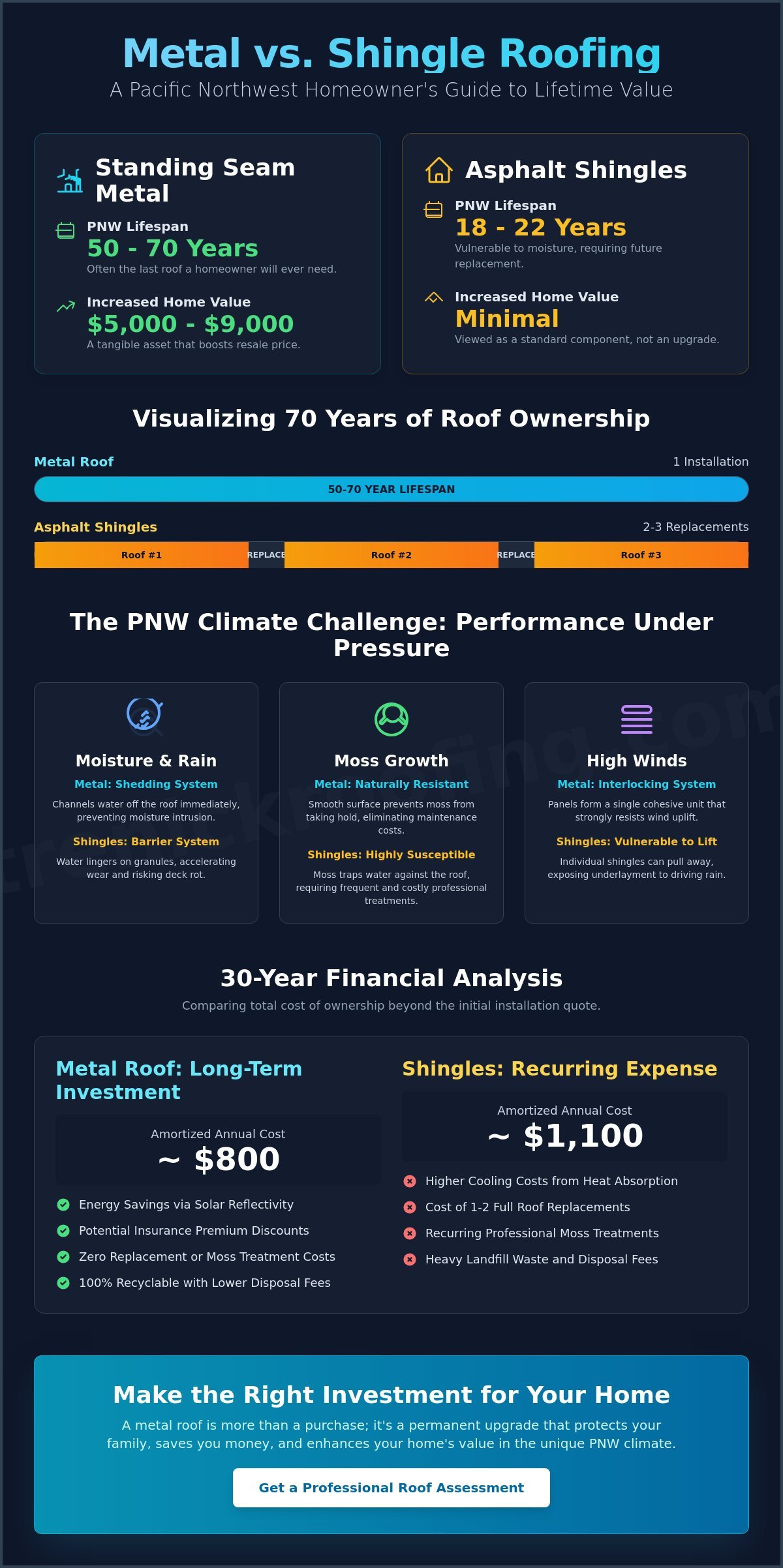
Living in the Pacific Northwest means your home faces a unique set of meteorological challenges. Whether you are in Vancouver or the windier corridors of the Columbia River Gorge, the climate acts as “hard mode” for roofing materials. When calculating the metal roof vs shingle cost Pacific Northwest homeowners often overlook how regional weather dictates the pace of deterioration. Asphalt shingles function as a barrier system, where water can linger on the granules. In contrast, standing seam metal is a shedding system designed to move moisture off the structure immediately.
Local wind patterns also play a decisive role in material performance. High winds near the Gorge frequently cause shingle lift, where individual tabs pull away from the deck and expose the underlayment to driving rain. Interlocking metal panels provide a structural advantage here. They are secured as a single, cohesive unit that resists uplift far better than traditional materials, reducing the likelihood of emergency repairs after a winter storm.
The Moss Factor: Maintenance Costs You Can’t Ignore
In Clark County, moss is more than an aesthetic nuisance. It acts like a sponge that holds water against your shingles, eventually leading to premature deck rot and the need for frequent roof repair in Battle Ground. While shingles require professional soft-washing or zinc treatments every few years to stay clear, metal roofing is naturally moss-resistant. The “wash and wear” nature of metal eliminates the recurring labor costs associated with keeping an asphalt roof functional in our damp environment.
Lifespan Expectations in Washington and Oregon
The gap in longevity is the most significant factor when analyzing the lifetime value of your investment. Industry data for the PNW indicates that asphalt shingles typically last between 18 and 22 years before moisture damage takes its toll. A professionally installed metal roof can protect a home for 50 to 70 years. This durability translates directly into equity; a metal roof with a transferable warranty can add between $5,000 and $9,000 to a home’s resale value in Washington. It’s often the last roof a homeowner will ever need to buy.
Financial Breakdown: Upfront Investment vs. Lifetime Value
Understanding the metal roof vs shingle cost Pacific Northwest homeowners face requires looking beyond the initial quote. In 2026, the price gap remains significant because metal requires specialized labor and high-grade materials. While a standard roof replacement in Battle Ground, WA using asphalt might seem budget-friendly today, the technical craftsmanship needed for standing seam metal ensures a much higher performance level. This 2026 metal vs. shingle cost guide highlights how labor dynamics in the Vancouver metro area favor experienced crews who understand precision flashing and panel alignment.
The 30-Year ROI Calculation
Over a 30-year period, the math shifts heavily in favor of metal. You’ll likely pay for two shingle installations and multiple professional moss treatments while a metal roof is still in its prime. ROI for roofing is defined as the percentage of the initial installation cost that a homeowner recovers through an increased property value at the time of sale. With an amortized annual cost of approximately $800 for metal versus $1,100 for shingles, the long-term savings are clear. Choosing metal is an investment in your home’s future equity rather than a recurring maintenance expense.
Local Disposal and Permit Factors
Disposal fees in Clark County can add up quickly during a tear-off. Asphalt shingles are heavy and head straight to the landfill, where they incur significant weight-based fees. Metal is different. It’s often 100% recyclable, which can lower disposal costs and align with local environmental initiatives. If you’re curious about how these factors apply to your specific property, a professional roof inspection in Vancouver can clarify your likely permit and tear-off expenses.
Decision Matrix: Which Roof is Right for Your Home?
Choosing the right material requires aligning your financial goals with your property’s long-term needs. While the metal roof vs shingle cost Pacific Northwest homeowners evaluate can be daunting, the decision often clarifies once you look at your residency timeline and maintenance preferences. A roof is a protective envelope; it should match how you intend to live in and care for your home over the next several decades.
Choose Standing Seam Metal if:
- You live in a high-wind area or near the Columbia River Gorge.
- You want a “zero-maintenance” solution that resists moss naturally.
- You plan to install solar panels in the future.
- You intend to keep the property for more than 15 years.
Choose Architectural Shingles if:
- You are working with a strict HOA that requires a traditional look.
- You plan to sell the home within the next 3 to 5 years.
- You need an immediate, high-quality solution on a tighter upfront budget.
When to Choose Metal Roofing
Metal is the premier choice for “forever homes” in SW Washington. If you plan to stay in your home for 15 years or more, the long-term savings on moss cleaning and replacement cycles make metal the most logical path. It’s also the ideal companion for steep-slope roofs where maintenance access is difficult and dangerous. For a detailed look at local projects, see our Expert Vancouver Metal Roofing Guide.
When to Choose Architectural Shingles
High-quality shingles are a reliable and versatile option for many families. They provide a classic aesthetic that complements Craftsman and traditional PNW home styles perfectly. We ensure these systems last as long as possible by using superior underlayment and advanced ventilation strategies to combat our regional humidity. This approach helps prevent the moisture trap that leads to early shingle failure.
Ultimately, the material is only as effective as the crew behind it. For homeowners outside our region, finding a contractor with high standards, such as Allesson Roofing, is key to a successful project. At Trenick Roofing, our “Performance First” philosophy means we focus on the technical details of the installation, ensuring your home stays dry and secure regardless of the material you select. We take pride in being a stable, community-rooted specialist that prioritizes your home’s safety over a quick sale.
Invest in Lasting Protection for Your PNW Home
Choosing between materials involves balancing your immediate financial goals with your home’s long-term needs. While the metal roof vs shingle cost Pacific Northwest residents navigate is a major factor, the real value comes from selecting a system that withstands our unique local climate. Metal provides a 50 to 70 year solution that naturally resists moss growth, whereas architectural shingles offer a reliable, traditional aesthetic for homeowners with a shorter residency timeline. Both options can secure your property when installed with precision and care.
As a family-owned and operated specialist since 2018, we focus on high-performance standing seam metal and premium shingle systems that are built to last. Our team uses performance-based payment structures to ensure your peace of mind throughout the entire process. We believe that professional roofing should be straightforward, honest, and rooted in the local community. We’re here to ensure your investment adds measurable value to your property while keeping your family safe from the elements.
Get a Transparent, No-Pressure Roofing Quote Today and take the first step toward a more secure home. We look forward to helping you make the best choice for your future.
Frequently Asked Questions
How much more does a metal roof cost than shingles in the Pacific Northwest?
A metal roof typically costs between two and three times more than a standard asphalt shingle installation in the Pacific Northwest. This initial investment covers the higher cost of premium materials and the specialized labor required for standing seam systems. While the upfront capital is higher, the amortized annual cost of a metal roof is approximately $800 compared to $1,100 for shingles. It’s a choice that prioritizes long-term durability and home value.
Is a metal roof too noisy during the heavy Vancouver rain?
No, a modern metal roof is not significantly louder than shingles during heavy Vancouver rain. When installed with high-quality underlayment and solid roof decking, the sound is muffled effectively. Your attic insulation also acts as a natural sound barrier. Most homeowners find the sound of rain on a metal roof to be no different than on traditional materials, ensuring your home remains a quiet sanctuary even during our most intense winter storms.
Do metal roofs attract lightning during PNW storms?
Metal roofing doesn’t attract lightning, even though it is a conductive material. Lightning typically strikes the highest point in an area regardless of what that point is made of. If a strike occurs, metal is actually safer than shingles because it’s non-combustible. It helps dissipate the electrical charge safely, providing an extra layer of security for homes in exposed or high-elevation locations throughout Washington and Oregon.
Can I install a metal roof over my existing shingles to save money?
We generally recommend a full tear-off rather than installing metal over existing shingles. While some local codes allow it, trapping old shingles under metal can lead to moisture retention and hidden deck rot in our damp climate. In Washington, the “25 percent rule” often requires a full replacement if damage is widespread. A clean start ensures your new system meets current building codes and performs reliably for its entire intended lifespan.
Will a metal roof make my home hotter in the summer?
A metal roof actually helps keep your home cooler by reflecting solar heat away from the structure. Asphalt shingles tend to absorb and hold heat, which can drive up your cooling costs during increasingly hot PNW summers. Metal releases heat quickly once the sun sets, reducing the load on your air conditioning system. It’s a proactive way to manage your home’s energy efficiency and interior comfort throughout the year.
What is the average lifespan of a shingle roof in Washington vs. a metal roof?
In the Washington climate, asphalt shingles have an estimated lifespan of 18 to 22 years, while metal roofs last 50 to 70 years. When evaluating the metal roof vs shingle cost Pacific Northwest homeowners find that metal is more affordable over time. It avoids the replacement cycle every two decades and adds between $5,000 and $9,000 to your home’s resale value. It’s a reliable investment in your property’s future.